
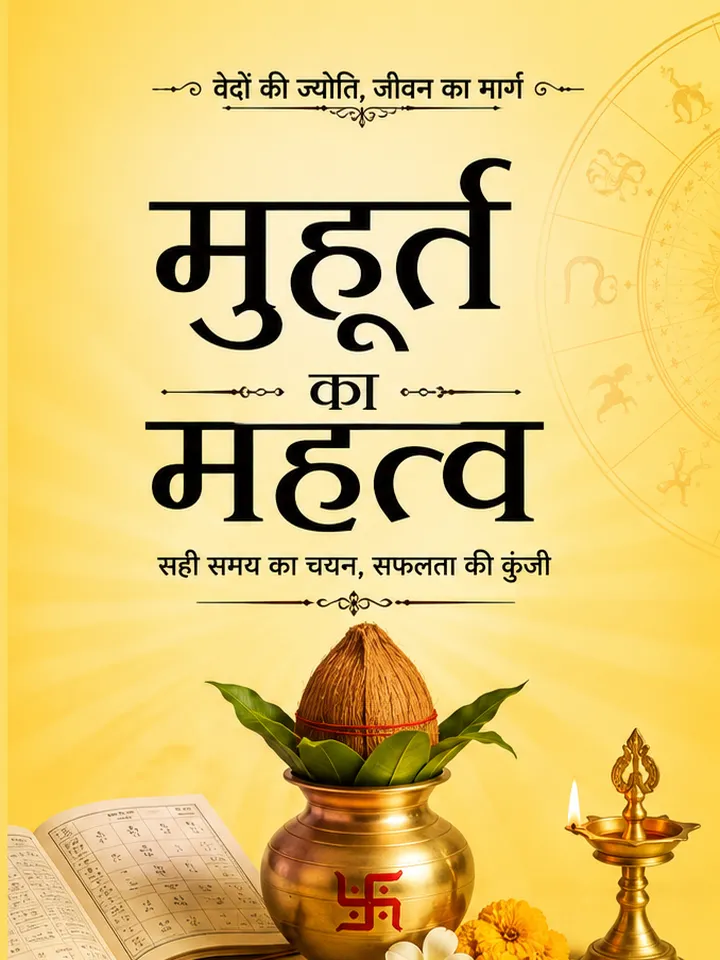
Ask two different people what "muhurat" means and you'll usually get two extremes. One will tell you it's outdated superstition — pick a good time or a bad time, the outcome is the same. The other will treat it as the entire answer — as if the right muhurat alone guarantees a good result regardless of preparation, intent or effort. Both miss what muhurat is actually for.
Time is not neutral
Indian time-science treats time the way a farmer treats a season — not as a uniform backdrop, but as something with its own qualities, some more supportive of certain actions than others. You already act on this instinct in ordinary life: you wouldn't plant a seed in the wrong season and expect a harvest, and you probably wouldn't schedule a difficult conversation for the one moment you know the other person is exhausted and irritable. Muhurat simply extends that same instinct with more precision — using planetary positions, tithi, nakshatra and yoga to identify windows where the surrounding conditions are more supportive of a specific kind of action.
What muhurat is for
Traditionally, muhurat is consulted for major beginnings: griha pravesh, marriage, starting a business, an important journey, or any new undertaking where you want the surrounding conditions working with you rather than against you. It is not consulted to guarantee an outcome — it is consulted to reduce unnecessary friction while you do the actual work of making that outcome happen.
The kunji — success still needs the key
This is the honest way to think about it: muhurat is a kunji — a key — not the door itself. A well-chosen muhurat for starting a business does nothing if the business plan is weak. A well-chosen muhurat for a wedding does not replace two people doing the work of building a relationship. What a good muhurat does is remove one layer of resistance — timing — so that your effort has a fair, supportive environment to land in.
How it actually gets calculated
A genuine muhurat isn't picked off a generic calendar. It accounts for the specific nature of the action being taken (a wedding muhurat and a business-opening muhurat are evaluated differently), the individual's own chart where relevant, and the avoidance of specific doshas and inauspicious combinations for that category of event. This is exactly the kind of practical, chart-aware calculation this book walks through — not a one-size-fits-all date list, but a way of thinking about timing that you can actually apply.
The real takeaway
If you remember one thing from all of this: muhurat is not about waiting passively for a "lucky" day. It's about pairing your effort with a moment that's genuinely working with you instead of against you — sakaratmak parinaam se pehle, sahi samay ki samajh.